

You run a café in Fitzroy, Brunswick or Richmond. This morning, a regular asked whether your takeaway cups are "actually compostable or just greenwashing," and you weren't sure how to answer. Your supplier emailed about the next plastic-ban deadline. The eco range on their catalogue costs 40 to 60 percent more than what you're buying now. You have three weeks to decide.
Every packaging supplier in Australia now has an "eco-friendly" range. The labels say compostable, biodegradable, plant-based, sustainable, earth-friendly, ocean-safe. Some of those terms mean something specific. Others mean almost nothing.
If you run a café, restaurant or food truck, you don't have time to decode marketing claims. You need packaging that works for your food, fits your budget, complies with the law, and does what it says on the box when your customer throws it away.
This guide breaks down the real differences between the materials on the market: what they cost, how they perform, and what actually happens to them after they leave your counter.
The Materials: What You're Actually Choosing Between
Sugarcane Bagasse
Bagasse is the fibrous material left after sugarcane stalks are crushed to extract juice. It's an agricultural byproduct. The sugar industry produces millions of tonnes of it annually, and turning it into packaging gives it a second life instead of burning or landfilling it.
How it performs: - Strong and rigid. Holds hot, oily and saucy foods without collapsing. - Microwave-safe and freezer-safe - Naturally grease-resistant without additional coatings - Available in clamshells, bowls, plates, trays and compartmented containers
Certification: Most sugarcane containers on the Australian market carry AS 4736 (industrial compostable) certification, the Australian Standard administered by the Australasian Bioplastics Association. Some also meet AS 5810 (home compostable).
End of life: Breaks down in commercial composting facilities within 90 days. In home compost, degradation takes longer but does occur. In landfill, it degrades significantly faster than conventional plastic, though landfill is never the intended destination.
Best for: Meal containers, clamshells, plates, bowls. Anywhere you'd previously use polystyrene or plastic containers. It's the workhorse material of the post-plastic café.
PLA (Polylactic Acid)
PLA is a bioplastic made from fermented plant starch (usually corn, sugarcane or cassava). It looks and feels like conventional plastic, which is both its strength and its weakness.
How it performs: - Clear and glossy. Ideal for cold cups, salad containers and deli lids where visibility matters. - Good structural integrity for cold applications - Not heat-resistant: deforms above 40-45°C, so unsuitable for hot food or drinks without modification - PLA-lined paper cups offer a compostable alternative to PE-lined cups for hot beverages
Certification: PLA products can be certified to AS 4736 (industrial compostable). Very few meet AS 5810 (home compostable) because PLA needs sustained high temperatures to break down.
End of life: This is where PLA gets complicated. It requires commercial composting at 55-60°C sustained (the AS 4736 test condition) for at least 12 weeks. In a backyard compost bin, a PLA cup will sit there looking exactly the same for years. In landfill, it behaves essentially like conventional plastic. It won't meaningfully degrade.
The catch: Australia's commercial composting infrastructure is limited. Only about 44% of Australian councils offer a FOGO (Food Organics Garden Organics) collection, and most jurisdictions currently exclude compostable packaging from those streams due to PFAS and contamination concerns (Compost Connect, February 2025). Not all processing facilities can handle PLA either. This means most PLA packaging in Australia ends up in landfill regardless of its certification.
Best for: Cold cups, clear containers and deli lids where transparency is essential. Also used as a lining in compostable coffee cups as an alternative to polyethylene.
Paper and Cardboard
The oldest packaging material is still one of the most practical. Modern food-grade paper products are engineered for specific tasks (grease resistance, moisture barriers, structural strength) without necessarily relying on plastic coatings.
How it performs: - Lightweight and printable. Ideal for branding and custom packaging. - Available in a vast range of formats: cups, bags, wraps, boxes, trays, sleeves - Grease resistance varies: some papers use natural wax or aqueous coatings, others rely on PLA or PE linings - Structural integrity is limited for wet or heavy foods without additional engineering
Certification: Uncoated paper and cardboard are universally recyclable and industrially compostable. Coated papers depend on the coating type. PLA-coated paper is compostable; PE-coated paper is generally not.
End of life: Clean, uncoated paper is one of the best end-of-life outcomes in packaging. It's accepted in every kerbside recycling system in Australia. Contaminated paper (grease-soaked, food-stained) can go to commercial composting or FOGO bins where accepted.
Best for: Coffee cups (with compostable lining), takeaway bags, sandwich wraps, bakery bags, and any application where branding matters. Paper is the packaging material that customers already know how to dispose of correctly.
Bamboo
Bamboo packaging has gained visibility in the sustainability space because bamboo grows fast, needs no pesticides, and sounds appealing on a menu board.
How it performs: - Strong and aesthetically distinctive. The natural grain gives a premium look. - Used primarily for plates, bowls, cutlery, and straws - Not widely available in the full range of container formats that bagasse offers - Generally more expensive per unit than bagasse or paper alternatives
Certification: Bamboo products can be certified compostable, but certification varies by product. Bamboo cutlery and straws are typically uncoated and naturally biodegradable. Bamboo fibre moulded into containers may include binding agents. Check the specific product's certification.
End of life: Uncoated bamboo products biodegrade readily in both commercial and home composting. Moulded bamboo fibre products vary depending on formulation.
Best for: Cutlery, straws, and venues where the visual aesthetic of bamboo aligns with the brand. For containers and cups, bagasse and paper generally offer better value.
Moulded Fibre (Wheat Straw, Reed, Other Agricultural Fibres)
A growing category of packaging made from various agricultural waste fibres (wheat straw, reed, rice husks). Similar in concept to bagasse but using different feedstocks.
How it performs: - Properties similar to bagasse: sturdy, microwave-safe, grease-resistant - Availability in Australia is more limited than bagasse - Visual appearance varies. Some products have a rougher, more natural texture. - Pricing is typically comparable to or slightly above bagasse
Certification: Varies by product. Look for AS 4736 or AS 5810 certification from the specific manufacturer.
Best for: Businesses looking for alternatives to bagasse that may want a different aesthetic or want to diversify their supply chain.
The Comparison Table: All Materials Side by Side
| Factor | Sugarcane Bagasse | PLA Bioplastic | Paper/Cardboard | Bamboo | Moulded Fibre |
|---|---|---|---|---|---|
| Hot food suitable | Yes | No (deforms >45°C) | With coating | Limited | Yes |
| Cold food suitable | Yes | Yes | Yes | Yes | Yes |
| Microwave safe | Yes | No | Check coating | No | Yes |
| Grease resistant | Naturally | Moderate | Needs coating | Limited | Naturally |
| Transparency | No | Yes (clear) | No | No | No |
| AS 4736 certified | Widely | Widely | Depends on coating | Varies | Varies |
| AS 5810 certified | Some products | Rarely | Uncoated only | Some products | Rarely |
| Kerbside recyclable | No | No | Yes (uncoated) | No | No |
| Home compostable | Some | No (needs heat) | Yes (uncoated) | Yes (uncoated) | Some |
| Price vs plastic | +60-80% | +40-60% | +30-50% | +80-120% | +60-90% |
| Custom branding | Limited | Good (printing) | Excellent | Limited | Limited |

The Uncomfortable Truth About Composting in Australia
Here's what most packaging suppliers won't tell you upfront: the majority of compostable packaging sold in Australia ends up in landfill. Not because the products don't work. They do. The infrastructure to process them simply doesn't exist at scale yet.
The national picture: - Only about 44% of Australian councils offer a FOGO (Food Organics Garden Organics) kerbside collection (Compost Connect, February 2025) - Most jurisdictions that do offer FOGO currently exclude compostable packaging from those streams, citing PFAS contamination concerns and processing-capacity limits - South Australia is a notable exception, actively encouraging compostable packaging in food service and retail
If You Run a Café in Victoria or NSW
Most cafés reading this guide are in Victoria or NSW. The picture there is starker than the national average suggests.
- Victoria currently restricts compostable packaging in FOGO to caddy liners only, citing capacity constraints, and is weighing a broader ban on compostable liners.
- NSW excludes compostable packaging from FOGO entirely, citing PFAS contamination concerns in commercial composting facilities (NSW EPA Position Statement, July 2022).
This doesn't mean compostable packaging is wrong. It means the disposal story you tell your customers should stop at "plant-based, replacing banned plastics" rather than "will be composted in the green bin."
What this means for your business:
Compostable packaging is still the right choice. It replaces banned plastics, it's made from renewable plant materials, and it breaks down faster than conventional plastic even in landfill. But don't build your entire sustainability message around "this cup will be composted" unless you've confirmed that your local waste stream actually supports it — and in Victoria or NSW, it currently doesn't.
Instead, lead with what's verifiable: - "Made from renewable plant materials" - "Replaces single-use plastic" - "Certified compostable to Australian standards"
These claims are factual and defensible regardless of what happens downstream.

Greenwashing Red Flags: What to Watch For
The packaging industry has a terminology problem. Here are the terms that should make you pause and ask questions.
"Biodegradable"
This word has no legal standard in Australia for packaging. Everything biodegrades eventually. A plastic bag will break down over centuries. Without a timeframe, a temperature specification, and a certification to AS 4736 or AS 5810, "biodegradable" tells you nothing useful.
Ask instead: "Is this certified compostable to AS 4736 or AS 5810? Can you provide the certificate?"
"Eco-friendly" / "Earth-friendly" / "Green"
Marketing terms with no regulated definition. The ACCC has flagged these exact claims as greenwashing risks when used without substantiation. A product can call itself eco-friendly while being made from the same materials as a conventional plastic container.
Ask instead: "What is this made from? What certifications does it carry?"
"Oxo-degradable" / "Oxo-biodegradable"
These are conventional plastics with additives that cause them to fragment into smaller pieces when exposed to heat or UV light. They don't actually biodegrade. They just become microplastics faster. Oxo-degradable plastics are banned in South Australia and increasingly restricted elsewhere. Avoid them entirely.
"Made from recycled material"
A valid claim, but it doesn't tell you whether the product itself is recyclable or compostable at end of life. A container made from recycled PET is still plastic and subject to the same bans as virgin PET if it's a single-use item in a banned category.
"Plant-based"
PLA is plant-based. It's also a plastic that won't break down in your backyard. "Plant-based" describes the raw material, not the end-of-life behaviour.
The golden rule: If a supplier can't produce an AS 4736 or AS 5810 certificate for a product they're calling "compostable," look for a different supplier.
Choosing the Right Material for Each Product
Rather than picking one material for everything, match the material to the job.
Hot Coffee and Tea
Best choice: Paper cup with PLA or aqueous compostable lining + compostable lid.
Single-wall cups work for standard serves. Double-wall cups eliminate the need for a separate sleeve: one less item to stock, one less thing in the bin. Pair with compostable lids.
Why not bagasse? Bagasse cups exist, but paper cups are more familiar to customers, lighter, and better for branding.
Cold Drinks and Smoothies
Best choice: PLA cups for drinks where customers want to see the contents. Paper cups for opaque drinks.
PLA's transparency is its killer feature for iced coffees, juices and smoothies. Browse the cold cup range for sizing options.
Meals and Main Courses
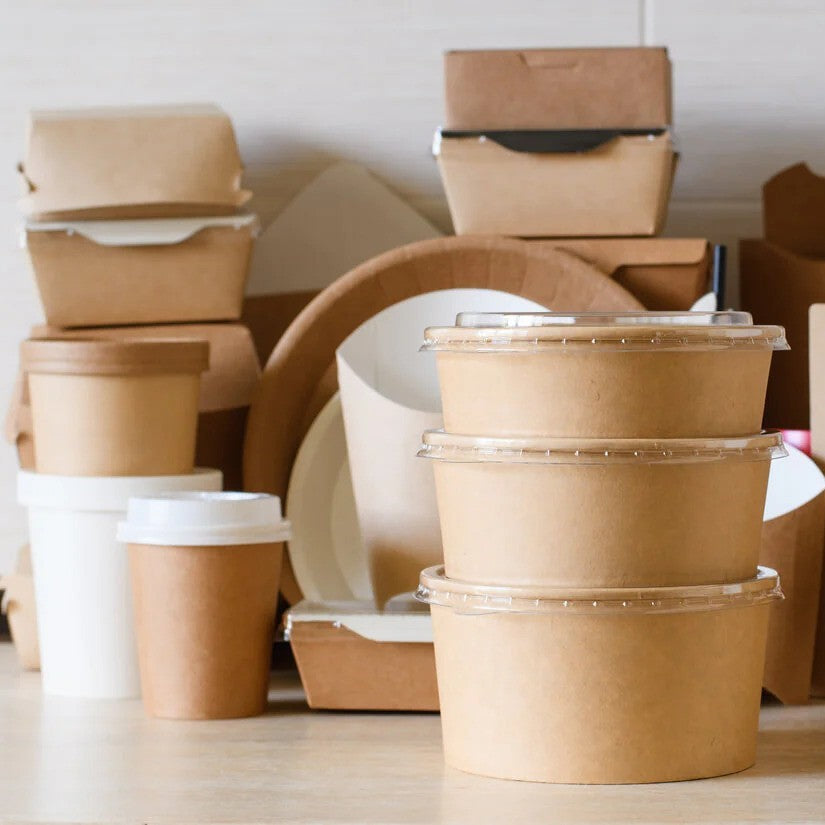
Best choice: Sugarcane bagasse clamshells and containers.
Bagasse is what it was made for: hot curries, rice dishes, pasta, burgers. It handles heat, grease and moisture without flinching. Available in single-compartment, two-compartment and three-compartment formats for combo meals.
Salads and Cold Deli
Best choice: PLA containers with clear lids for visual appeal. Paper bowls with clear PLA lids as an alternative.
Customers eat with their eyes first. A clear lid that shows the food inside drives impulse purchases at the deli counter.
Sandwiches, Wraps and Bakery Items
Best choice: Paper bags and wraps.
Paper bags in kraft or white are universally recyclable, cheap, and easy to brand. For sandwiches, greaseproof paper wraps do the job without needing a rigid container.
Cutlery and Napkins
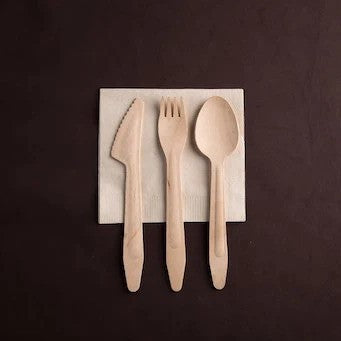
Best choice: Wooden or bamboo cutlery. Paper napkins.
Offer on request, not by default. This simple change saves material and money.
Real-World Cost Planning
Here's how to think about packaging costs when switching to eco-friendly materials. We'll use a typical Melbourne café serving 150 takeaway orders per day as the baseline.
Daily Packaging Profile (Typical Café)
| Item | Quantity/Day | Conventional Cost | Eco-Friendly Cost | Daily Difference |
|---|---|---|---|---|
| 8oz coffee cups + lids | 120 | $7.20 | $10.80 | +$3.60 |
| 12oz coffee cups + lids | 60 | $4.80 | $7.20 | +$2.40 |
| Cold cups + lids | 30 | $2.40 | $3.60 | +$1.20 |
| Meal clamshells | 40 | $4.00 | $7.20 | +$3.20 |
| Cutlery sets (on request) | 25 | $1.50 | $2.50 | +$1.00 |
| Paper bags | 80 | $4.00 | $6.40 | +$2.40 |
| Straws | 50 | $0.75 | $1.50 | +$0.75 |
| Daily total | $24.65 | $39.20 | +$14.55 |
Annual impact: Roughly $5,300 extra per year in packaging costs for this size café.
Estimates based on typical wholesale pricing for independent cafés in Australia, 2026. Bulk purchasing, supplier negotiations and product selection significantly affect actual costs.
Putting It in Perspective
- That $5,300 is about $14.50 per day — less than selling three extra coffees
- It's roughly 1-2% of annual revenue for a café turning over $300K-$500K
- It's less than the cost of a single non-compliance fine in most states
- Customers increasingly expect it. The competitive risk of not switching may outweigh the cost.
How to Reduce the Gap
Consolidate your supplier. Ordering cups, containers, cutlery, bags and cleaning supplies from one source instead of three or four unlocks better volume pricing and reduces delivery costs. Pakio's full range covers all these categories.
Right-size aggressively. Audit your three most-used containers. If you're putting a regular-sized meal into a large clamshell because that's what's in stock, you're paying for air. Match container to portion.
Eliminate what you can. Do you need to bag a single coffee? Do you need a fork with soup? Removing unnecessary items saves more than switching them.
Time your purchases. Some suppliers offer seasonal discounts or new-customer pricing. Stock up when pricing is favourable. Most packaging has a long shelf life.

How to Talk About Sustainability Without Overselling
Your customers care about sustainability, but they also have finely tuned radar for inauthentic messaging. Here's how to communicate honestly.
Do say: - "We use compostable packaging made from sugarcane and paper" - "Our cups are certified compostable to Australian Standard AS 4736" - "We've replaced all single-use plastics with plant-based alternatives"
Don't say: - "Our packaging saves the planet" (it's packaging, not policy) - "100% eco-friendly" (nothing in single-use packaging is 100% eco-friendly) - "This cup will be composted" (unless you've verified local processing)
The best approach: A small, honest sign near your counter or register. One or two sentences. No greenwashing, no guilt-tripping. Something like: "All our takeaway packaging is made from plant-based, compostable materials. We're working to reduce our environmental footprint, and yours."
That's it. Understated. Factual. Customers respect it.
Frequently Asked Questions
What's the single best material for café packaging?
There isn't one. Sugarcane bagasse is the most versatile for food containers. Paper is best for cups and bags. PLA wins on transparency for cold drinks. Match material to application.
Can I use compostable packaging for delivery apps like UberEats?
Yes. Compostable packaging works for delivery. Sugarcane clamshells in particular hold up well during transport. The main consideration is ensuring lids seal properly to prevent spills, and that containers maintain temperature for the delivery window.
How do I know if my current packaging is compliant?
Check for AS 4736 or AS 5810 certification marks. If there's no certification visible on the product or its packaging, contact your supplier and ask for a certificate of conformity. If they can't provide one, switch suppliers.
Will customers pay more for eco-friendly packaging?
Most won't pay a visible surcharge. But research consistently shows that consumers prefer businesses that demonstrate environmental responsibility. It influences where they choose to buy, even if there isn't a line item on the receipt. The packaging cost is part of your cost of goods, not a customer-facing price increase.
Should I switch everything at once or gradually?
Gradually is usually more practical. Start with the items you order most frequently. That's where you'll get the biggest impact and the best volume pricing. Switch cups and lids first (highest volume), then containers, then bags and accessories.
What happens to compostable packaging in a regular bin?
It goes to landfill, like everything else in a general waste bin. In landfill, compostable materials degrade faster than conventional plastics but slower than they would in a composting facility. The environmental benefit is primarily in the production phase (renewable raw materials, lower carbon footprint in manufacturing) rather than the disposal phase.
The Bottom Line
Choosing eco-friendly packaging isn't a single decision — it's a set of decisions, matched to what your business actually serves, what your budget allows, and what your local waste system can handle.
The practical starting point: sugarcane for hot food containers, paper for cups and bags, PLA for clear cold drink cups, wooden cutlery on request. This combination covers the needs of most Australian cafés and restaurants while meeting compliance requirements in every state.
Don't chase the latest "miracle material." Don't overpay for bamboo when bagasse does the same job for less. And don't claim more than you can verify. Your customers will respect honest sustainability more than inflated green claims.
Founded by George Weng and Josh Trenerry in Melbourne's Keysborough, Pakio is a young Australian-founded packaging supplier stocking 2,000+ SKUs across café, foodservice and retail. From single-wall coffee cups and bagasse clamshells to custom retail boxes, everything you need for a compliant, eco-friendly switch sits in one catalogue. Wholesale pricing, free Melbourne metro shipping over $200, nationwide delivery, and no-minimum orders for independent cafés. Need help choosing? Get in touch.